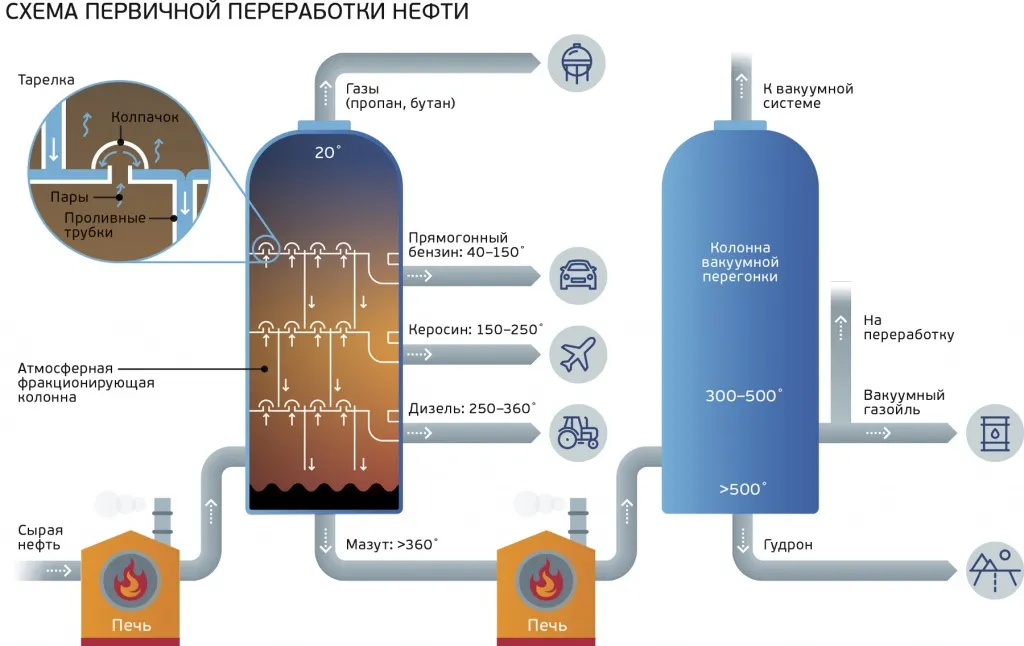
Oil that has just been extracted from underground contains a number of impurities. The main ones are formation water with dissolved mineral salts, and gases. These substances have a negative effect on storage, transportation and the subsequent refining of this "black gold".…
Before crude oil is sent for refining, it must be prepared.
This process includes several stages, namely:
- Removal of dissolved associated gases (oil stabilization);
- Desalting;
- Drying of the oil (dehydration).
The first stage is stabilization.
The purpose of stabilization is to separate gases and gas condensate from the oil (gaseous products of the C1–C4 series: propane, butane, methane and ethane, as well as C5+ gas condensate). This is done before refining to prevent the loss of significant amounts of light hydrocarbons during transportation and storage and, as a result, to avoid changes in the composition of the oil. The environmental factor must not be forgotten either: losses of gas and light gasoline fractions can have a negative impact on the atmosphere. That is why these products are separated from the oil before refining. Depending on a number of conditions, separation is carried out directly at the oil production site, at booster stations, and at gas processing plants.
First, the associated gas is separated in gas separators by successively reducing the pressure and flow rate of the oil (multistage separation). Stabilization occurs as a result of desorption (the reverse of gas absorption by a liquid) and separation of volatile liquid hydrocarbons (gas condensate). With this separation method, up to 2% of C1–C4 hydrocarbons remain in the oil.
Today there are modern, energy-efficient methods of transporting crude oil with dissolved associated gases through pipelines.
Desalting and dehydration of oil.
Removal of water and salts from oil takes place directly at the oil fields in oil treatment units and at refineries in ELOU-AVT units. Dehydration and desalting of oil are linked to the breaking of water-oil emulsions. At production sites, naturally occurring emulsions formed during extraction are broken. At refineries, emulsions are created deliberately in order to wash the oil repeatedly. As a result of washing, mineral salts dissolve and are removed together with the water. At the first treatment stage, the content of metal chlorides and water is reduced to 0.5–1.0% (100–1,100 mg/l). At the second, to 0.05–0.1% (3–5 mg/l).
You can watch the demonstration video at this link.